Get Recommended by ChatGPT: 2026 Playbook
SOCi visibility stats, citation research, OppAlerts correlations, schema and answer-first tactics, crawler checks, plus honest limits on steering AI mentions.

According to SOCi's 2026 Local Visibility Index reporting, AI-mediated search surfaces reportedly recommend roughly 1.2% of local business locations while the remainder never receive a direct recommendation-style mention in that framing. Translation: assistants are choosing a microscopic slice of brands when someone asks conversational questions instead of paging through blue links.
This is a playbook, not philosophy. Deep background sits in our answer engine optimisation explainer for Toronto businesses. Here we assume you already believe assistants matter and want the operating steps: how citations form, what to implement, how to sanity-check outcomes, and what honest limits look like.
- $3,000 Growth CreditFree assessment · credit applied to onboarding. See if you qualify →
A different scoreboard than Google
Maps pack dominance does not promise assistant mentions. The inverse also happens: middling SERP placement with surgically precise service copy can outperform a cluttered category leader inside tools that summarise instead of listing ten URLs. Engines weight extractability, corroboration, and relevance to the verbatim question users now type or speak aloud.
If bulky competitors outspent you on classic SEO moats, AI discovery is comparatively open: fewer practitioners have shipped schema, conversational service depth, or reputable third-party footprints intentionally. Territory you claim now compounds while attention is still fractured between legacy dashboards and conversational surfaces.
How ChatGPT-style systems shortlist businesses
At a pragmatic level models stitch answers from layered sources such as crawlable websites, structured listings, review ecosystems, and open-web discussion venues. Vendor research underscores how much cites trace to marketer stewarded properties: Yext's public write-up on AI citations attributes roughly forty-four percent of studied citations to first-party websites and forty-two percent to manageable listings with the remainder split among reviews or social influences and uncontrollable publishers.
Independent breakdowns such as Profound's summarised platform citation mixes show models diverging dramatically: conversational engines that lean on live retrieval (for example Perplexity in their sample window) overweight community publishers like Reddit compared with models that cite Wikipedia or SERP snippets more aggressively. Assume your category may not match aggregate charts. Always corroborate with your own question list audit.
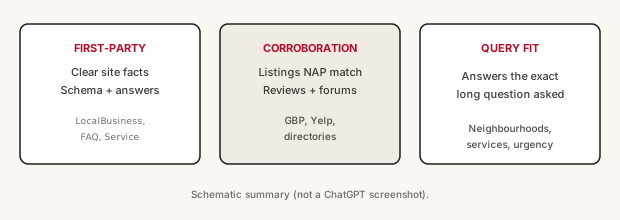
Three tests decide whether your brand stays in the invisible majority: readable facts about what you deliver and where, independent confirmation that the entity is credible, and direct alignment with how the shopper phrased the assistance request.
What correlation studies imply
OppAlerts' multi-industry study clusters signals correlated with appearing inside ChatGPT-derived recommendations: domain-level search authority, solid ordinary rankings, and healthy backlink profiles remain top-tier predictors alongside snippet visibility.
Signals people label "AEO-only", such as presence inside Common Crawl corpora or structured entities, behave as amplifiers rather than substitutions for legitimacy in traditional search ecosystems. OppAlerts stresses industry-specific nuance when applying those tiers mechanically.
For ongoing macro tracking complementary to OppAlerts, BrightEdge's AI search trackers remain a useful pulse on citation behaviour shifts inside Google-mediated answers.
Google's 2026 search reset and why AEO is still foundational SEO
Search Engine Journal's coverage of Google's AI Mode expansion underscores longer conversational prompts, multimodal inputs gaining share, and follow-up chatter climbing sharply. Google's public narrative continues to insist generative optimisation is an extension of core SEO craftsmanship, not an unrelated dark art: crawlability, truthful expertise, structured clarity, and backlink-worthy narratives still describe the sandbox.
Content must match how buyers phrase assistance today: granular intent strings such as same-day wasp nest removal in Scarborough outperform thin pages repeating a single city head term. Measurement lags surfaced through Search Console for AI-exclusive panels, reinforcing why manual auditing with consistent prompt banks matters.
Execution playbook
1. Encode machine-readable identities
Structured data communicates labelled facts Google outlines in its structured data primer. Local programmes should prioritize LocalBusiness, FAQPage payloads for repeatable Q&A snippets, granular Service markup per offer, plus AggregateRating when data is truthful. Tactical walkthrough examples appear in guides from WPRiders and peers.
2. Answer-first prose
Lead paragraphs with decisive facts assistants can excerpt. Narrative warmup sentences that postpone the payoff increase the likelihood the crawler jumps to competitors who spoon-feed numbers upfront. Preserve nuance in paragraphs two and beyond once the succinct answer is nailed.
3. Entity discipline
Normalise naming, casing, incorporation suffixes, punctuation, addresses, and phone numbers everywhere they appear so graph-style systems reconcile a single coherent entity. Invest in substantive About narratives and, when warranted, reference-grade listings such as Wikidata for brands large enough to justify the maintenance burden.
4. Earn corroborative mentions responsibly
Thin single-domain footprints read suspicious. Pursue diligently completed profiles (Yelp, sector directories, Better Business Bureau when authentic), diversify fresh reviews ethically, participate helpfully wherever buyers already seek advice rather than astro-turfing threads. Fraudulent citation schemes age poorly.
5. Local clarity beyond boilerplate swaps
GBP primary categories should mirror documented buyer language. Layer neighbourhood-specific narratives, transit cues, and distinct services per trade line instead of mechanically duplicated city stubs. Structural clarity powering Maps is the same lucidity conversational models extrapolate. Insectica's Toronto case study shows how combined paid plus organic groundwork benefitted discoverability broadly.
6. Keep AI crawler paths open
Audit robots directives, CDN firewalls, and WordPress plugins that auto-block GPTBot clones. Locked doors undo every copy investment. Combine this check with HTTPS health, crawl budget basics, and anything inhibiting faithful HTML snapshotting.
Publishing portfolio for citations
Thin schema without substance loses to materially deep sites. Borrow the portfolio ordering Abhishek Kaushik surfaced (see his LinkedIn profile for the originating framework cues) and adapt downward for local trades: exhaustive buying guides, schema-rich standalone service URLs, clustered conversational FAQs, trench commentary, credible origin narratives, procedural HowTo content, surfaced testimonials with review markup, transcripts of expert commentary, plus publishable operational statistics when accurate.
Start top-heavy on guides plus service granularity. Layer the remainder quarterly so each asset answers another latent question buyers pose to assistants.
Monthly audit routine
Without a universal leaderboard export, reproducibility beats vibes. Maintain a numbered prompt backlog mirroring buyer language, run those prompts across ChatGPT, Perplexity, and Google's AI surfaces, screenshot or log outputs, annotate competitors, revise schema or narrative gaps, then re-run thirty days later. Expect stochastic drift as models refresh.
Supplement assistant checks with trending branded search volume analytics and uplift in tracked phone/email leads to catch zero-click halo effects. FindSkill's checklist-style audit article offers additional lenses if you outsource portions of diligence.
Measurements when dashboards stay incomplete
Track presence frequency on the fixed prompts, relativise share-of-voice against named rivals, monitor downstream branded demand. Untidy beats imaginary precision so long as the methodology stays consistent meeting to meeting.
What honesty requires
Nobody can guarantee permanent ordering inside generative summaries. Behaviour shifts abruptly. What you sell instead is compounding readiness: unmistakable structured identity, corroborative proof, ethically earned reputation, iterative content that tracks evolving question shapes, resilient crawl paths. Agencies promising instantaneous guaranteed mentions are misaligned with observable platform variance.
Seven-day starter checklist
- Ship LocalBusiness + FAQ schema on flagship URLs.
- Rewrite three hero service sections answer-first.
- Audit robots logs for AI crawler exclusions.
- Reconcile GBP and external listings for identical NAP data.
- Record baseline answers for ten customer questions across assistants.
Want hands-on help? Reach our contact form for a conversational visibility audit keyed to real buyer prompts, or explore our AEO service lane.
Shah Md. Rifat
Content Strategist · Stratezik · Toronto, ON · LinkedIn
FAQ
- What should I prioritise first for local ChatGPT visibility?
- Implement LocalBusiness schema plus answer-first copy on priority service pages so the model can extract who you serve, where, and how to reach you. Pair that with crawler access checks and consistent name, address, and phone signals across listings.
- Can I pay to be recommended organically in ChatGPT?
- No. Paid placements come from products such as ChatGPT Ads, which are separate from unpaid recommendations earned through relevance, clarity, corroboration, and authority signals.
- How long does it take to start appearing in ChatGPT answers?
- Timelines compress versus crowded head-term SEO programmes when competitors have not optimised yet, often weeks to a few months depending on existing domain authority and how fast you ship schema plus content fixes. OppAlerts-style correlation studies emphasise classic search authority as a dominant tier, so very weak domains still face a slower climb.
- Do I need page-one Google rankings to be recommended?
- You do not need the top organic slot. Correlation studies show strong regular-search visibility predicts LLM citations, but anecdotes also show divergence: excellent Maps rankings do not guarantee AI mentions, and some businesses with middling SERP placement still earn recommendations when information is exceptionally clear.
- How do I measure answer engine optimisation without a rankings dashboard?
- Track a fixed question list monthly across ChatGPT, Perplexity, and Google AI experiences, noting presence and which competitors appear. Layer branded search and direct traffic trends as proxies for zero-click recommendations.
Sources
- National Law Review: AI search visibility index coverage
- Yext: Brand-managed citation research summary
- Profound: Platform citation mixes
- OppAlerts: LLM ranking factor study
- Search Engine Journal: AI Mode / core update recap
- Search Engine Journal: Local AEO best practices briefing
- ALM Corp: Answer engine optimisation playbook
- HubSpot: AEO trend overview
- Niseus: Long-form ChatGPT positioning guide
- WPRiders: Schema markup for AI search
- FindSkill.ai: Local business audit perspective
- BrightEdge: AI citation research hub
- Abhishek Kaushik ("portfolio" lineage): LinkedIn reference
- Stratezik XML sitemap