ChatGPT Ads 2026: Setup, Costs, When to Skip
How OpenAI Ads Manager Beta places sponsored recommendations in ChatGPT, what context hints replace keywords, reported pricing bands, and honest fit notes.

For 25 years, paid advertising has worked the same way. You bid on a keyword. Someone types that keyword. Your ad shows up. The auction is mechanical, the intent is shallow, and the platforms got rich teaching you how to game it.
ChatGPT Ads breaks that model. There is no keyword to bid on. There is no search results page. The matching happens inside a conversation between a person and a model, and a sponsored placement may appear when the system judges your offer relevant to that moment. Almost every advertiser we have spoken to is approaching it with Google or Meta muscle memory that does not transfer cleanly.
This guide covers what we see as of May 2026: how accounts work, how placements are structured, pricing narratives in trade press, geography, category gates, and why context hints replace keyword lists. Primary reference should stay OpenAI's Help Center quickstart and sibling articles, because beta UIs change.
- $3,000 Growth CreditFree assessment · credit applied to onboarding. See if you qualify →
Want the optimization playbook, not just the platform overview? Get our free ChatGPT Ads cheat sheet, context hints, bid-floor tests, industry readiness, and the measurement stack from practitioners running real budgets.
What ChatGPT Ads actually is (and what it is not)
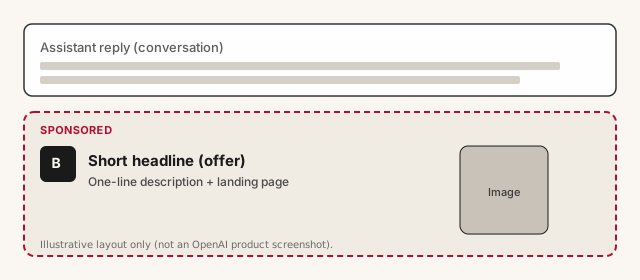
The surface product is Ads Manager Beta at ads.openai.com: register an advertiser, build campaigns, upload creative, set budgets, and read performance. Underneath, it behaves more like a contextual recommendation layer than a classic search auction. Industry reporting from Adventure PPC and ALM Corp describes measured frequency on the order of one sponsored appearance per several conversations, with a compact card: favicon, headline, short copy, image, clearly labelled sponsored.
It is not a SERP, not a display network across partner sites, and not a video or carousel unit. You do not buy the literal text the user typed. Native levers stay thin on purpose: country, device, sometimes region, tier (Free versus Go), plus your creative and context hints.
Where ads run and who sees them
As of mid-May 2026, advertiser accounts were live for the United States, Canada, Australia, and New Zealand. Expansion to additional markets has been reported in Adweek and Digiday; ALM Corp summarises United Kingdom, Japan, South Korea, Brazil, and Mexico as part of that wave, with European Union preparation noted in public commentary.
Country and currency choices at signup are effectively permanent for that advertiser record. A Toronto operator picking Canada commits to CAD billing for the life of that account, which matters for agencies managing cross-border brands.
End users who see ads are on Free or Go (the lower-cost paid tier). Plus, Pro, Business, Enterprise, and Education do not receive these placements. The reachable audience is huge, but it skews away from buyers who already pay full freight for ChatGPT. If your offer assumes executive or enterprise readers, channel fit may be weaker than headline reach implies.
How to set up an advertiser account
OpenAI structures the workflow as three beats in the quickstart: create the account, build campaigns, monitor after launch. Expect 20 to 40 minutes of focused setup plus review time.
- Sign in with a work-backed OpenAI account or create one.
- Complete verification and onboarding in Ads Manager Beta.
- Before anything serves: add advertiser name and favicon, configure billing and payment method, invite collaborators. OpenAI emphasises one business owner creating the advertiser, then inviting the team.
Identity checks run through Persona-style flows with tax IDs and registration documents stricter than many ad platforms; have paperwork ready. Adthena notes agencies cannot stand up client accounts outright: the client creates and owns the shell, then grants access. Operationally, prefer role-based owner emails so a departing CMO does not strand billing ownership.
Deeper UI detail lives in Ads Manager Beta account setup and the Ads Manager overview.
Building your first campaign
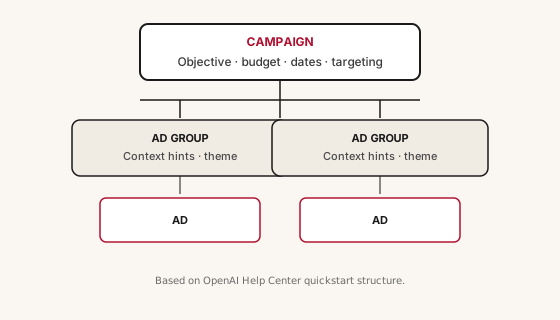
You can use guided creation in the UI or bulk upload via schema templates for scale. The hierarchy matches OpenAI's Help Center: campaign, then ad group, then ad (see create campaigns, create ad groups, create ads).
Objectives
Reporting typically centres Reach (CPM-weighted impressions) versus Clicks (CPC-weighted landing page visits). Conversion columns depend on your measurement setup. Performance buyers usually start on Clicks unless there is a deliberate awareness brief.
Ad groups and context hints
This is the mental model shift. There is no keyword list, negative keyword list, interest taxonomy, or lookalike builder. Each ad group accepts context hints: short thematic descriptions of conversations where you belong. OpenAI describes hints as broad signals, not exact match tokens. The model weighs hints, creative, and the live dialogue together.
If you sell dehumidifiers, hints might cover basement moisture, humidity control, or indoor air comfort; you are describing moments of usefulness, not buying tokens.
Targeting controls
Structural filters stay limited: country, region or city where supported, device type, subscription tier (Free versus Go). Conversation-level relevance does the heavy lifting.
Creative
Units combine title, body, square-ish image, landing URL, plus advertiser name and favicon. OpenAI publishes craft guidance in Create Ads for ChatGPT. Third-party spec sheets such as AllAdSpecs cite tight character ranges and a 256 pixel minimum image; treat them as planning defaults until your build screen disagrees.
Write headlines like a concise answer, not a tagline contest. Thumbnails are small; avoid illegible in-image text.
Review and launch
Submit bundles for policy review. After go-live, use launch and monitoring guidance : dashboard status, hover reasons for "Not serving," edit and resubmit where fixes are allowed.
What it costs (and how the story moved in months)
Trade reporting tracked two eras. Early 2026 CPM-only buying landed around sixty US dollars CPM with a two hundred thousand dollar minimum according to ALM Corp; The Next Web noted CPMs drifting as inventory widened. From April 2026, Search Engine Journal and Digiday described CPC buying nearer three to five US dollars per click with a fifty thousand dollar minimum for entrants on that model.
Directionally, that CPC band sits above many generic search auctions and below LinkedIn-style B2B pricing in common anecdotes. Whether conversion efficiency clears your bar is an empirical test, not a press headline.
If contractual minimums exceed your experiment budget, the honest move is to wait rather than force a micro-spend that cannot learn.
Launch, measurement, and support
Native reporting emphasises impressions, clicks, spend, CTR, average CPC, average CPM, and conversions when tagged. Views include tables, charts, and CSV exports. There is no auction insights screen, impression share, or demographic breakdown comparable to mature search UI. Plan UTMs (for example utm_source=chatgpt) and bridge to GA4 or your warehouse yourself.
OpenAI publishes product context in Ads in ChatGPT and basics; policy lives in the ad policies. For metric hygiene, Adventure PPC lists practical dashboard fields worth tracking in beta.
Categories allowed (and excluded)
OpenAI's published policies emphasise conservative allow-lists: household goods, local services, travel, entertainment, digital products, education, with explicit exclusions such as healthcare, financial services, legal, alcohol and tobacco, gambling, dating and adult content, political and sensitive social issue messaging. If you are blocked by category, there is no public guaranteed reopening date.
If you are not in an allowlisted country yet
You can wait for the rollout, stand up a compliant entity where you genuinely operate, or prepare creative and measurement now so you are not starting from zero when accounts open. The winners on new surfaces are usually ready before the checkbox appears.
Straight talk for buyers
ChatGPT Ads is a credible beta with real inventory, CPC mechanics, and policy guardrails. It is also early: thinner reporting, lighter targeting, tight copy limits, awkward agency onboarding, and minimums that screen out small tests.
For many Toronto service businesses optimising for next-month leads, Search and Maps work still wins on efficiency. National brands with conversational use cases, eligible categories, and budget for a 90-day learning curve are better candidates. Treat the first quarter as tuition, staff it with someone curious about assistive surfaces, not only a keyword auction traditionalist.
If you want a blunt-fit review for your offer, use our contact form or book time via our contact form.
FAQ
- Who can advertise with ChatGPT Ads in 2026?
- As of mid-May 2026, advertiser onboarding has been available in the United States, Canada, Australia, and New Zealand. Public reporting describes further markets (including the United Kingdom, Japan, South Korea, Brazil, and Mexico) opening on a rolling basis, with European Union expansion reportedly in preparation.
- What does ChatGPT Ads cost?
- Industry reporting described early CPM-only pricing around sixty US dollars CPM with a two hundred thousand dollar minimum commitment. From April 2026, reporting commonly cites roughly three to five US dollars cost per click with a fifty thousand dollar minimum for new advertisers on the CPC model. Treat numbers as directional; confirm in Ads Manager and contracts.
- How do you target ChatGPT Ads if there are no keywords?
- You choose structural filters such as country, region or city where supported, device type, and subscription tier (Free versus Go), plus context hints: short thematic descriptions of conversations where your offer fits. The model matches hints and creative to live dialogue; it is not exact keyword matching.
- Should a Toronto SMB buy ChatGPT Ads today?
- If the goal is more local leads next month, Google Search Ads, a strong Google Business Profile, and local SEO still tend to win on efficiency for typical service trades. ChatGPT Ads makes more sense for national brands with conversational use cases, category eligibility, and budget for a multi-week learning curve, including minimum spend expectations in beta.
Sources
Official OpenAI
- Quickstart: Launch your first campaign
- Ads Manager Beta overview
- Ads Manager Beta account setup
- Create campaigns for ChatGPT
- Create ad groups for ChatGPT
- Create ads for ChatGPT
- Launch campaigns
- Ads in ChatGPT
- Ads in ChatGPT: The basics
- Ad policies
- Testing ads in ChatGPT
- Our approach to advertising and expanding access
- New ways to buy ChatGPT ads
Industry reporting
- Marketing Dive: ChatGPT Ads Manager
- Adthena: Ads Manager beta setup
- Search Engine Land: CPC in ChatGPT
- Digiday: CPC ads inside ChatGPT
- Search Engine Journal: CPC band reporting
- ALM Corp: early CPM minimums
- The Next Web: shift to CPC
- Adweek: pilot expansion
- Digiday: new markets
- ALM Corp: geography expansion recap
- AllAdSpecs: sponsored card dimensions
- Adventure PPC: reporting metrics
- Adventure PPC: placement mechanics
- ALM Corp: ChatGPT Ads explained
Stratezik sitemap: https://www.stratezik.com/sitemap.xml · Paid search services
Shah Md. Rifat
Content Strategist · Stratezik · Toronto, ON · LinkedIn